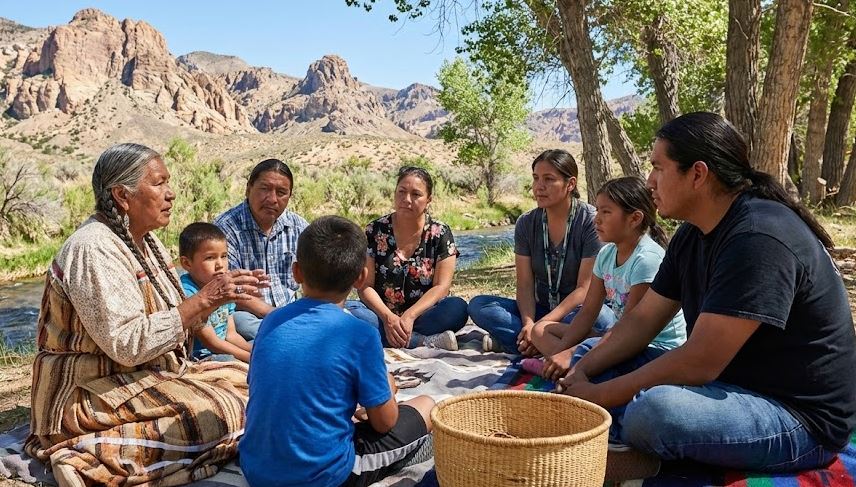
Today, these communities comprise 28 separate federally recognized tribes, bands, colonies, and community councils throughout Nevada, carrying on cultural traditions that are deeply intertwined with the land. The four major tribal groups of Nevada are the Numu (Northern Paiute), Newe (Western Shoshone), Nuwu (Southern Paiute), and Wašiw (Washoe).
The Four Great Basin Nations
1. Wašiw (Washoe)
The Washoe people, or Wašiw, are considered the original inhabitants of the territory surrounding Lake Tahoe (known in their language as DáɁaw). Their ancestral homelands stretch across the Sierra Nevada mountains into the Pine Nut Range.
- Key Distinction: The Washoe language is unique and distinct from the Numic languages spoken by their neighbors, suggesting their presence in the region predates the arrival of other Great Basin groups.
- Traditional Life: They were masters of the high-altitude environment, migrating seasonally to fish in Lake Tahoe during the summer and harvesting pine nuts (ťágɨm) in the valleys during the fall.
2. Numu (Northern Paiute)
The Northern Paiute, or Numu, traditionally inhabited the western and northwestern parts of Nevada. Their territory included the areas around Pyramid Lake, Walker Lake, and the Black Rock Desert.
- Key Distinction: Many Northern Paiute bands were traditionally named after their primary food source, such as the Kucadikadi (Lake Fish Eaters) of the Mono Lake area.
- History: The Numu people played a significant role in early conflicts with settlers, most notably the Pyramid Lake War of 1860, in an effort to protect their land and resources.
3. Newe (Western Shoshone)
The Western Shoshone, or Newe, historically occupied the vast central heartland of Nevada, including areas that now contain Great Basin National Park and the Ruby Mountains.
- Key Distinction: The Newe were nomadic hunter-gatherers, traveling across the immense Great Basin to hunt game and gather pinyon pine nuts, a critical food source.
- Legacy: The Western Shoshone have a long history of legal battles with the U.S. government over treaty rights and ancestral land claims, making them a key voice in the modern fight for Native American sovereignty.
4. Nuwu (Southern Paiute)
The Southern Paiute, or Nuwu, are the indigenous people of southeastern Nevada, with their ancestral lands encompassing the Las Vegas Valley, Red Rock Canyon, and the surrounding Mojave Desert regions.
- Key Distinction: Their history in the region is deeply tied to the natural springs and water sources, such as the areas now occupied by Las Vegas.
- Modern Community: The Las Vegas Paiute Tribe is a federally recognized tribe with a reservation just north of downtown Las Vegas, maintaining their cultural presence in a dramatically changed environment.
Modern Identity and Sovereignty
The history of the Native American nations in Nevada is one of immense adaptation and perseverance in the face of colonization, forced relocations, and the establishment of Indian reservations and "colonies" (small parcels of land often near cities).
Today, these sovereign tribal nations are focused on cultural preservation, language revitalization, and economic development, ensuring their deep and continuing connection to the land of Nevada remains strong for future generations.