

 KENTUCKY - The name "Kentucky" is widely believed to be derived from an Iroquoian word, Kenta-ke, meaning "Meadow Land" or "At the Prairie." Other linguists point to the Wyandot word Kah-ten-tah-teh, meaning "Land of Tomorrow." While a common myth suggests the name meant "Dark and Bloody Ground," this was largely a colonial misinterpretation; to the many nations that moved through it, Kentucky was a lush, abundant heartland of salt licks and fertile hunting grounds.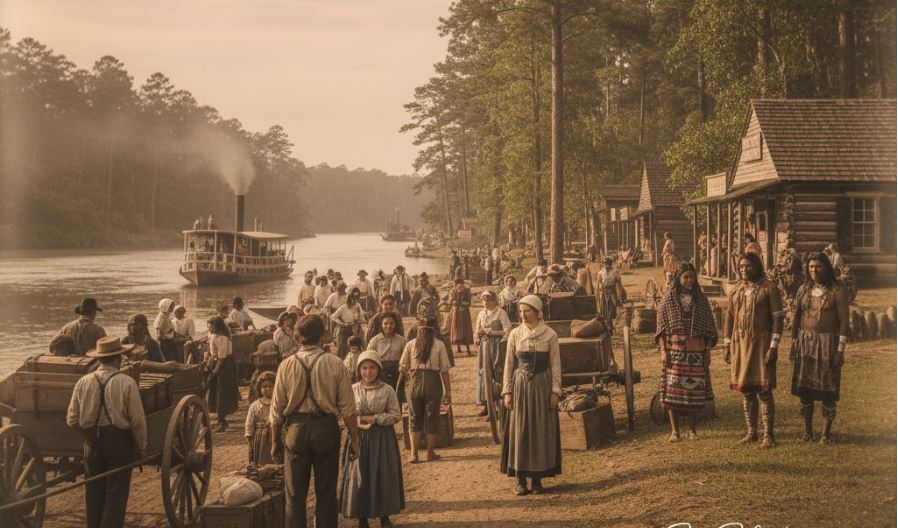
Long before it was the "Bluegrass State," Kentucky was a vital crossroads for the Shawnee (Loyal Shawnee), the Cherokee (Tsalagi), the Chickasaw (Chikasha), and the Wyandot.
A Shared Heartland of Nations
Kentucky's geography—bounded by the Ohio River to the north and the Appalachian Mountains to the east—made it one of the most significant hunting and trading regions in North America. Rather than being owned by one tribe, it was often shared:
- The Shawnee: Centered in the Ohio River Valley, the Shawnee viewed the central and northern blue-grass regions as their primary hunting domain. They established semi-permanent villages and were known as the "Southerners" by other Algonquian-speaking tribes.
- The Tsalagi (Cherokee): The Cherokee held vast territories in the south and east. They viewed the Cumberland Plateau and the mountains as an extension of their Appalachian homeland, utilizing the region for seasonal resource gathering.
- The Chikasha (Chickasaw): The western tip of Kentucky, nestled between the Mississippi and Tennessee rivers, was part of the Chickasaw homeland. They maintained a powerful presence on the bluffs overlooking the great river systems.
Regional and Cultural Designations
Indigenous groups defined Kentucky by its unique geology—specifically its abundance of salt and its vast, open meadows:
- The Ohio River: Known to the Iroquois as the O-he-yo ("Great River") and to the Shawnee as Pelewa Sipi, this waterway was the northern boundary of the Kentucky world.
- The Bluegrass Region: Indigenous hunters maintained this area through controlled burns, creating the "Great Meadow" that supported massive herds of bison and elk.
- The Salt Licks: Sites like Big Bone Lick were known to nearly every tribe in the East. They were neutral zones where nations gathered to harvest salt and hunt the animals drawn to the mineral springs.
Significant Indigenous Place Names
The map of Kentucky is a linguistic tapestry of the nations that traversed it. The Cumberland River was known to the Shawnee and Cherokee as the Warioto. The city of Paducah is named in honor of the Padouca (a name often associated with the Comanche or Apache), reflecting the broad reach of Indigenous influence.
The Kentucky River itself carries the State ancestral name. Owensboro sits on land once known as Yellow Banks, a translation of a descriptive name the Shawnee gave to the river's clay cliffs. In the south, Keavy and Oconee carry echoes of Cherokee influence. Even the Appalachian name, used for the eastern mountains, is derived from the Apalachee people.
A Living Legacy
While the Shawnee, Cherokee, and Chickasaw were largely pushed out of Kentucky by the early 19th century, their connection to the land remains. Today, the Cherokee Heritage Center and various Shawnee cultural organizations work to preserve the history of the "Meadow Land."
By recognizing the origin of Kenta-ke, we acknowledge that Kentucky was never an empty wilderness, but a carefully managed and highly valued landscape that served as a center of life for the diverse nations of the Ohio Valley and the Southeast.
